During labour, it is good to stay as active as possible, and to try different positions. By doing this you will encourage your baby through the birth canal in the best position for birth, whilst also helping your own comfort and coping ability. Staying active and upright is also known to shorten the length of labour.You can try:
walking
standing with support from your birth partner
going up and down stairs
rocking/swaying
using a birthing ball
sitting upright or squatting
all fours position (on your hands and knees) or kneeling
lying on your side, supported by pillows (when you want to rest).
During birth, your midwife will support you to try different positions. It is important to listen to your body, and try whatever feels right for you. The positions you can adopt may depend on whether you’ve chosen to have a water birth, or if you have an epidural.
During labour, your midwife will listen to your baby’s heartbeat to check his/her wellbeing, and to ensure he/she is coping well with labour. There are three different ways your midwife can check this, by using either:
a hand-held machine
a pinard stethoscope; or
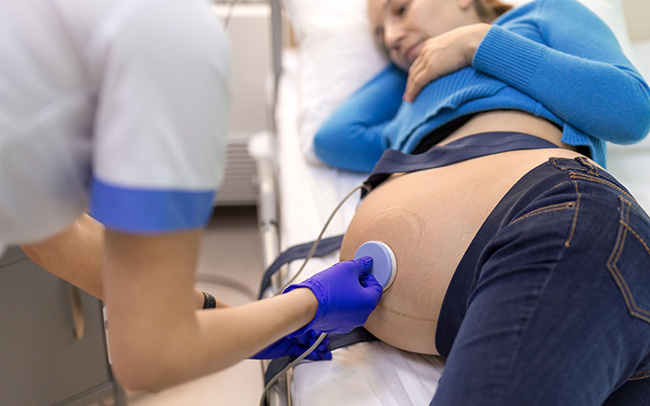
continuous electronic fetal monitoring.
If you have had a normal and healthy pregnancy, and your labour started naturally after 37 weeks, you will normally be offered monitoring using a small-hand held machine which produces the sound of your baby’s heartbeat. This is the same machine that your midwife/doctor used to listen to your baby’s heartbeat during pregnancy. Your midwife will listen to your baby’s heartbeat intermittently and regularly throughout labour. Your midwife may choose to listen to your baby’s heartbeat with a pinard stethoscope. Like a traditional stethoscope you will not be able to hear the heartbeat but the midwife will hear it clearly. Continuous electronic fetal monitoring (sometimes called a CTG) is a machine which is used to record your baby’s heartbeat and the contractions of your womb constantly throughout labour. It may be recommended that you have this type of monitoring if you’ve had any complications during pregnancy or labour. Midwives and/or doctors will look at this recording regularly throughout labour. You will need to wear two belts around your abdomen to keep the monitors in place. In some units a wireless machine may be available (this is known as telemetry), which means you may be able to move around more freely. Additional monitoring may be recommended if your midwives or doctors are concerned about your baby’s heartbeat during labour, this could be either:
a fetal scalp electrode (FSE) which is attached directly to your baby’s head
a fetal blood sample (FBS), this test involves checking your baby’s oxygen levels by taking a small sample of blood from your baby’s head.
This stage is the time between the birth of your baby and the expulsion of your placenta. After your baby is born, he/she will still be attached to the umbilical cord, which is attached to the placenta inside the womb. The cord should be left intact and not cut immediately, unless there is a problem with your baby’s breathing, or you are bleeding heavily.There are two options for the delivery of your placenta. The first option is known as physiological third stage, and the other is active third stage.
Physiological third stage
This option may be suitable if you are planning a natural birth. If you require an assisted birth, or if your midwife is worried you may be at a higher risk of bleeding after birth, this may not be recommended for you. Some research has found that bleeding after birth can be slightly increased if the placenta is expelled naturally, however if you are fit and healthy with good iron levels pre-birth, this is unlikely to cause any problems for you. After your baby is born, he/she will remain attached to the placenta via the umbilical cord, which provides oxygen and blood supply whilst your baby also starts to breathe. After 10-15 minutes this blood supply will naturally stop as the placenta separates from the womb. At this point the cord can be secured and cut. Soon after you will feel some mild contractions in the womb and perhaps an urge to push. You may find adopting upright positions helps, and your placenta will slide out easily. This is normally painless as the placenta is soft.
Active third stage
If you opt for an active third stage, or if your midwife recommends it after the birth of your baby, your midwife will give you an injection of a medication that causes the womb to contract. This injection normally takes a few minutes to work, and at this point the baby’s cord will be secured and cut. Your midwife/doctor will then place gentle pressure on your lower abdomen and carefully pull on the umbilical cord, causing the placenta to deliver. This process normally takes between 10-20 minutes.
This stage of labour starts when your cervix is ten centimetres dilated, and the baby’s head is moving into the birth canal. This is normally accompanied by a pressure in your bottom, followed by an urge to push which can feel difficult to control and similar to the sensation of needing to open your bowels.Some women may not get an urge to push, particularly if they have an epidural. If this is the case, your midwife will help guide you by feeling for a contraction on your abdomen and letting you know when to push. Your midwife will check your baby’s heartbeat regularly and support you to try different positions. When your baby’s head is nearly born, your midwife will encourage you to gently breathe and avoid pushing if possible. This ensures your baby’s head stretches your perineum slowly and can help reduce tearing.The second stage of labour ends with the birth of your baby. This stage of labour can last up to four hours if it’s your first baby, and is usually much quicker if it’s your second or third baby.
Active labour is often said to begin when contractions are strong, regular and lasting at least 60 seconds, and your cervix is open to at least four centimetres.During the first stage of labour your contractions will continue to come regularly, and become progressively stronger. This stage of labour can last around 6-12 hours if it is your first baby, and is often quicker if it is your second or third baby.When you arrive at your maternity unit (or your midwife comes to your home) and throughout the first stage of labour your midwife will offer regular assessments of your progress and wellbeing, and the wellbeing of your baby, including:
your observations (blood pressure, pulse and temperature)
abdominal palpation
listening to your baby’s heartbeat
vaginal examination to assess the progress of labour and position of your baby.
Your midwife will support you with different positions and coping strategies, including pain relief if needed. If the midwife is concerned about you or your baby at any point, she will ask a senior midwife or obstetrician for a second opinion. This can sometimes mean transferring to the labour ward if you are at home or in a midwifery led unit.Towards the end of the first stage you may experience something known as ‘transition’ which can make some women feel scared or out of control. This is common and is soon followed by an urge to push as the cervix reaches ten centimetres dilated, and the baby moves down into the birth canal. Your midwife will support you closely during this stage.
Early labour (sometimes called the latent phase of labour) can last anything from a few hours to a few days. In this time you may have periods of regular contractions, followed by periods of irregular contractions that can even stop for a few hours. During early labour your cervix will go from being thick, closed and firm to being soft, thin and stretchy. This change enables the cervix to start opening.
The amniotic sac is the fluid filled bag that your baby grows inside during pregnancy. This sac will break before your baby is born. When it breaks, the fluid will drain out from the vagina.Most women’s waters break during labour, but it can happen before labour starts. If your waters break, you may feel a slow trickle or a sudden gush of fluid. This fluid is normally clear or pink in colour, however sometimes a baby can pass their first poo (called meconium) inside the sac, causing the fluid to become green or yellow.If you think your waters have broken it is important to call your maternity triage/assessment unit straight away, particularly if you think you can see meconium. If you are less than 37 weeks pregnant this may be a sign of premature labour. If you think your waters have broken, wear a thick sanitary pad as your midwife will ask to see this when you attend your maternity unit for a check-up. You can also take a photo of the initial loss of fluids as this can help with assessment.Make sure you take plenty of pads and a change of clothes with you on your journey into the maternity unit as, once the waters are broken, you will continue to leak amniotic fluid. If your waters do break before labour, it is likely that your labour will start naturally within 24 hours, however if it doesn’t start it may be recommended that your labour is induced (started with the aid of medications) to reduce the risk of infection for both you and your baby. Your maternity team will discuss this with you and agree a plan if this is the case.
When early labour (sometimes known as the latent phase) starts, you may experience irregular contractions that vary in duration and strength. This can sometimes last for a few days, and it is important to rest when you can until they become regular. When your contractions become strong and regular, it may be helpful to start timing them (approximately how often they are coming and how long they last for). If it is your first baby, you will normally be advised to come to the maternity unit when your contractions are every three minutes and lasting for 60 seconds. If it is your second or subsequent baby, you may be advised to come to the maternity unit when your contractions are every five minutes and lasting for 45 seconds. You can call your maternity unit for support at any time, and a midwife will advise you on when to come to the maternity unit. If you’re planning a homebirth, your midwife will come and visit you at home at the appropriate time. Many women find trying different positions, walking, a warm bath, distraction and relaxation techniques, massage and resting in between contractions useful when at home. It is important to have regular light snacks (even if you don’t feel hungry) and to sleep when possible. It is also important to drink, taking regular small sips of fluids in order to remain hydrated. You don’t need to drink more than you would normally.

 During labour, it is good to stay as active as possible, and to try different positions. By doing this you will encourage your baby through the birth canal in the best position for birth, whilst also helping your own comfort and coping ability. Staying active and upright is also known to shorten the length of labour.
You can try:
During labour, it is good to stay as active as possible, and to try different positions. By doing this you will encourage your baby through the birth canal in the best position for birth, whilst also helping your own comfort and coping ability. Staying active and upright is also known to shorten the length of labour.
You can try: